


All systems of medicine are a construct, in the very literal sense that at decisive moments we can often name the people who decided what would and would not count as part of their system of medicine (and often why). Medicine is constructed because people select, combine, exclude, standardize, and transmit particular practices. Constructed does not mean arbitrary, ineffective, or unreal. It means the system could have been assembled differently, and that its present form has a history.
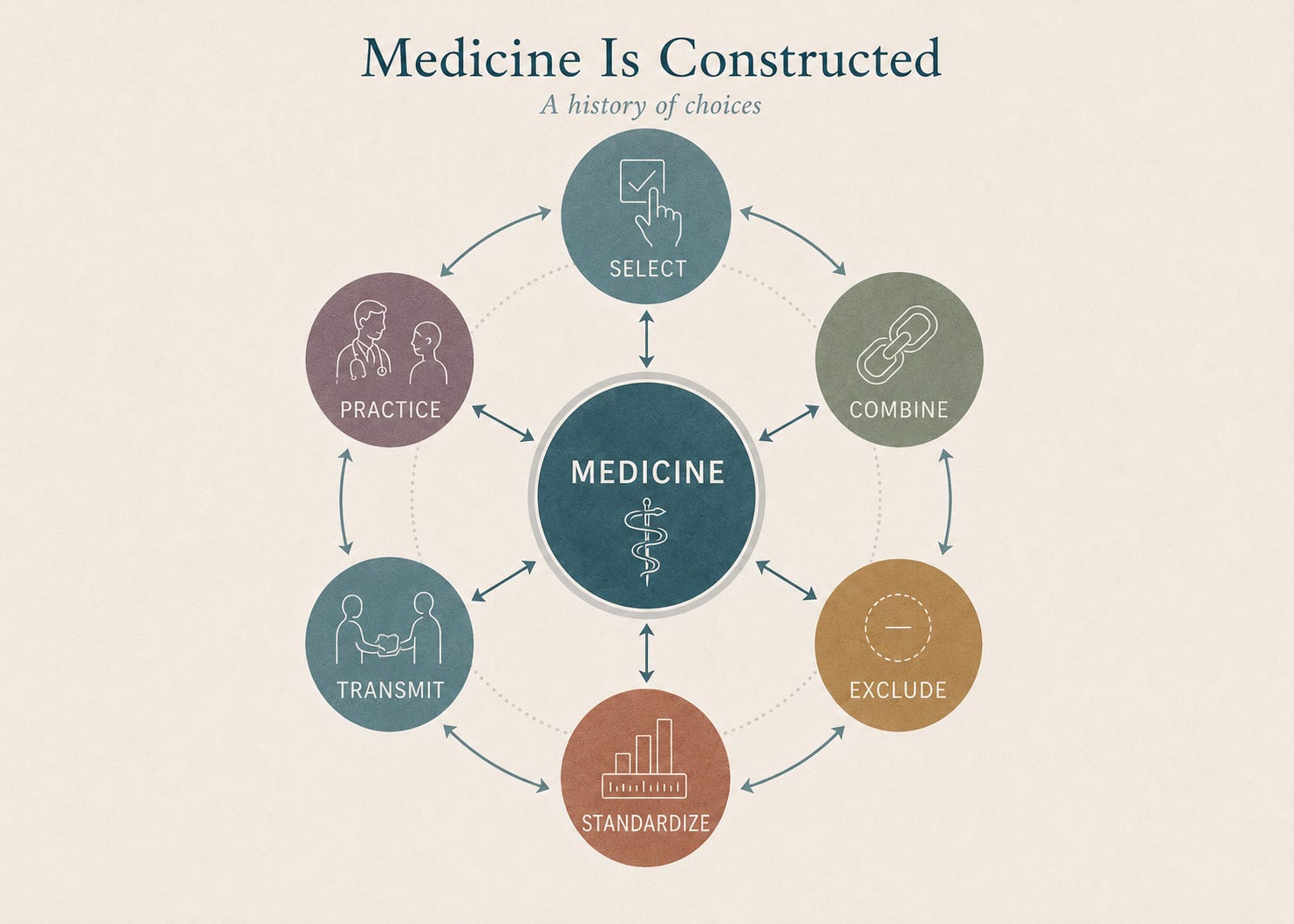
Historians of every major medical system have written about this. A lot of people practicing those systems don’t know it. Our systems train us in what to ignore, and what to pay attention to, and what counts as an answer. I want to talk about what the construction of medicine looks like at the level of patient interaction, but for that conversation I need you to read your own system’s history and understand how heterogeneous practices get chosen, organized, institutionally defended, and eventually narrated as a coherent tradition.
Modern Western Medicine
When the American Medical Association was founded, its ethics code forbade its members from consulting with anyone whose practice was considered exclusive dogma, including the eclectics and homeopaths. That line, that boundary, kept the irregulars out, but other than that it really settled nothing about what medicine was (Starr 1982; Burrow 1963).
Regular physicians differed wildly in how they practiced, depending on the region they lived in, the season, the patient’s constitution, and they all defended these very distinct variations as doctrine (Warner 1986). An even deeper split, between measuring outcomes and reasoning from known mechanisms, crystallized among the Paris-trained physicians of the 1830s and 40s (Warner 1998) and resurfaces almost unchanged in the evidence-based medicine debates of the 1990s.
Also, germ theory wasn’t a clean revolution but a thirty-year negotiation among multiple competing germ theories (Worboys 2000). There was a strong holistic medicine movement that ran inside Harvard and Johns Hopkins from the 1920s to the 50s (Lawrence and Weisz 1998). And, intentional or not, specialization made the pluralism a permanent thing: a cardiologist and a psychiatrist reason differently about the nature of disease (Stevens 1998; Weisz 2006).
Evidence-based medicine began as an internal revolt against the authority of eminence and immediately got pushback (Timmermans and Berg 2003). And then, almost as quickly, prominent EBM advocates were arguing that its authority had been appropriated by the vested interests of big pharma (Greenhalgh et al. 2014). And Annemarie Mol spent years documenting that, at least in one Dutch hospital, atherosclerosis was a different disease depending on whether you were in the clinic, the vascular lab, or the pathology department, and what really held these different atheroscleroses together was the referrals, case conferences, scheduling, and a lot of paperwork (Mol 2002).
Traditional Chinese Medicine
The first official use of "Traditional Chinese Medicine" seems to be 1955, in material written for foreign readers. Mao had been wishy-washy about traditional practices before this, but in 1954 the state strongly embraced them for both political and practical reasons. Then colleges opened, and in the 1960s the first unified national textbooks were written. Historian Kim Taylor argues that regularization of Chinese medical knowledge is itself a twentieth-century phenomenon, and that the very idea of a unified basic theory of TCM is “strictly a PRC China phenomenon” (Taylor 2005, 145).
Before the ‘60s there wasn’t a single standardized system of Chinese medicine that looks like what “TCM” does today. Demonic medicine, systematic correspondence, and pragmatic drug therapies had coexisted with folk practices and countless family lineage-based practices (Unschuld 1985). Modern acupuncture descends from big changes in the 1930s, when points were re-described against nerve anatomy and the needles themselves changed (Andrews 2014). And even after standardization, the practice in China stayed plural (Scheid 2002). What we know of as TCM is, according to historians of Chinese medicine, a mid-century product, and the actual traditions underneath are older and stranger and contradictory. Decisions were made about what constitutes Traditional Chinese Medicine by people whose names we know.
Ayurvedic Medicine
A different version of the same process happened in India, twice. Kenneth Zysk argues the empirical medicine at Ayurveda's core came out of heterodox ascetic communities, Buddhist and Jain renunciants, and was later assimilated by Brahmans into an orthodox frame, with the story of divine transmission added afterward (Zysk 1991). The second version came with the British orientalists splitting a multitude of cultural practices into a “great tradition” written in Sanskrit texts and a “little tradition” of actual practices.
Indian revivalists then turned that split into a program, and in 1938, the Bombay Medical Practitioners Act was passed, which started the shift towards college and board examinations (Langford 2002). The current central focus on the tridosha system is modern: classical disease causation often ran on misplacement, not imbalance, and Mukharji traces chakras' popularity to modern Ayurveda’s early interaction with protoplasmic cell theories. As early as the 1920s, the doshas were being equated with hormones by the tradition’s own reformers, a handful of families, mostly upper-caste, mostly Western-qualified (Mukharji 2016).
The actual classical texts are massive (D. Wujastyk 1998), and lineages that diverge from institutional Ayurveda are still being practiced and documented, like in Todd Caldecott's collection of the teachings of Vaidya Mana Bajra Bajracharya, a Newar vaidya in Kathmandu (Caldecott 2011). The divergences are fun to explore.
Modern Western Herbal Medicine
North American herbalism split from domestic medicine and medical practice with Samuel Thomson, who codified the New England folk medicine he learned from Widow Benton. Alison Denham suspects he was also influenced by the seven years of evenings with Dr. Bliss, a medical student who had studied with a root doctor and rented a house on the farm (Denham, in Tobyn, Denham, and Whitelegg 2011). Thomson systematized a simple qualitative binary into a patented system of six remedies, where the rights to use the system and the training material were provided to families for twenty dollars (Berman 1951). Buying in also gave you access to exclusive pharmacy sources for those formulas. I’ve pondered whether this medicine-of-the-people/commercial-pharmacy marriage isn’t the foundation of the herbal multi-level marketing companies that came out of the 1960s Utah Mormon Neo-Thomsonian herbal revival.
The physiomedicalists and eclectics, among my primary early influences, wanted a more formal system, using the new physiology as their explanatory and conceptual models, intentionally moving away from the explicit qualities Thomson used because those were too reminiscent of the Greek qualities (Cook 1869; Haller 1994, 1997). They built colleges, built pharmacies, built legacies, and then, through a combination of mismanagement, changing cultural perspectives about health, and poor adaptation to new scientific discoveries, both distinct schools of medicine collapsed into ineffective skeletons of their former selves. They crumbled completely once the Flexner Report held medical schools to newly constructed standards (which were reasonable and which they legitimately failed to meet).
Parts of these schools lived on in books, regional practices, families, and scattered practitioner lineages. From the 60s-80s, Rosemary Gladstar, Michael Moore, David Winston, Christopher Hobbs, and others selectively recovered pieces of these schools and synthesized them into the North American Herbal Revival.
I come from this North American revival lineage, both the Utah Mormon Neo-Thomsonian revival (thanks, Steven) and the energetic lineage (thanks, Matthew, David, and Phyllis). The North American energetic system is maybe the best-documented construction of all of our examples, because its builders were explicit about how they constructed their practices and systems. Matthew Wood acknowledges that the six tissue states derive from Thurston (1900) and the taste-to-action model largely from David Winston, and then credits LeSassier and Moore and Light and Gladstar (Wood 2004). Winston names his own sources as Chinese medicine, Cherokee and Southeastern traditions, the eclectics, the physiomedicalists, Ayurveda, and Unani-tibb (Winston 2022). Tierra put the East-West synthesis in his book’s subtitle (Tierra 1988).
There are many, many concepts from the North American Herbal Revival that aren’t Western or traditional at all (which neither detracts from nor establishes clinical effectiveness, but does give us a lot of juicy explorations for the future).
And I should nod towards my U.K. friends who have their own well-documented history of ongoing construction. Around 1978 the National Institute of Medical Herbalists removed physiomedicalism from its training course, wanting to modernize, prescribe more European herbs, and lean less on American ones (Denham, in Tobyn, Denham, and Whitelegg 2011). Folks made decisions about what was and wasn’t part of their system, and we know when and why.
Why am I telling you all of this?
There were choices made in your system’s construction that you don’t realize were choices because they have been there so long they seem to be part of the foundation. Choices that you don’t know the alternatives to, or the original arguments for or against.
Construction is not bad, wrong, or a falsehood. It is simply what it is, out of necessity and human nature. So is a house. It’s constructed, and you can live in it.
To talk about how to build constructs better, we need to be able to separate ourselves from the story, and our system’s structure from its literalized legitimacy narrative.
Almost every claim of unbroken, unchanged ancient transmission you have ever heard, of any system, is at best a stretch, and if you practice, the actual history of your own system is the one you’re responsible for.
Our system supplies the patterns we are trained to notice, the questions we think to ask, and the names we give what happens next. But construction is ongoing at the practitioner level, and it happens again in the room, between practitioner and patient.
When you’ve sat with this a while, we’ll talk about what construction looks like in the room with a person (and maybe a plant).
-Thomas Easley, Registered Herbalist (AHG)
P.S. This is a doorway, not a complete history. Follow the references and the historians working from within traditions I have only touched here.
P.P.S. Literalized legitimacy narrative, a legitimizing story mistaken for literal history is Forrest Chalmers’ phrase, and it's excellent, and I’d have credited him above where I used it, except it would have broken the reading experience I wanted.
References
Modern Western Medicine
Burrow, James G. AMA: Voice of American Medicine. Baltimore: Johns Hopkins Press, 1963.
Greenhalgh, Trisha, Jeremy Howick, and Neal Maskrey. “Evidence Based Medicine: A Movement in Crisis?” BMJ 348 (2014): g3725. https://doi.org/10.1136/bmj.g3725.
Lawrence, Christopher, and George Weisz, eds. Greater Than the Parts: Holism in Biomedicine, 1920–1950. New York: Oxford University Press, 1998.
Mol, Annemarie. The Body Multiple: Ontology in Medical Practice. Durham, NC: Duke University Press, 2002.
Starr, Paul. The Social Transformation of American Medicine. New York: Basic Books, 1982.
Stevens, Rosemary. American Medicine and the Public Interest. Berkeley: University of California Press, 1998 (orig. 1971).
Timmermans, Stefan, and Marc Berg. The Gold Standard: The Challenge of Evidence-Based Medicine and Standardization in Health Care. Philadelphia: Temple University Press, 2003.
Warner, John Harley. The Therapeutic Perspective: Medical Practice, Knowledge, and Identity in America, 1820–1885. Cambridge, MA: Harvard University Press, 1986.
Warner, John Harley. Against the Spirit of System: The French Impulse in Nineteenth-Century American Medicine. Princeton: Princeton University Press, 1998.
Weisz, George. Divide and Conquer: A Comparative History of Medical Specialization. New York: Oxford University Press, 2006.
Worboys, Michael. Spreading Germs: Disease Theories and Medical Practice in Britain, 1865–1900. Cambridge: Cambridge University Press, 2000.
Traditional Chinese Medicine
Andrews, Bridie. The Making of Modern Chinese Medicine, 1850–1960. Vancouver: UBC Press, 2014.
Scheid, Volker. Chinese Medicine in Contemporary China: Plurality and Synthesis. Durham, NC: Duke University Press, 2002.
Taylor, Kim. Chinese Medicine in Early Communist China, 1945–63: A Medicine of Revolution. London: Routledge, 2005.
Unschuld, Paul U. Medicine in China: A History of Ideas. Berkeley: University of California Press, 1985.
Ayurvedic Medicine
Caldecott, Todd, ed. Ayurveda in Nepal: The Teachings of Vaidya Mana Bajra Bajracharya. PhytoAlchemy, 2011.
Langford, Jean M. Fluent Bodies: Ayurvedic Remedies for Postcolonial Imbalance. Durham, NC: Duke University Press, 2002.
Mukharji, Projit Bihari. Doctoring Traditions: Ayurveda, Small Technologies, and Braided Sciences. Chicago: University of Chicago Press, 2016.
Wujastyk, Dominik. The Roots of Ayurveda: Selections from Sanskrit Medical Writings. London: Penguin, 1998.
Zysk, Kenneth G. Asceticism and Healing in Ancient India: Medicine in the Buddhist Monastery. New York: Oxford University Press, 1991.
Modern Western Herbal Medicine
Berman, Alex. “The Thomsonian Movement and Its Relation to American Pharmacy and Medicine.” Bulletin of the History of Medicine 25 (1951): 405–428, 519–538.
Cook, William H. The Physio-Medical Dispensatory. Cincinnati, 1869.
Denham, Alison. “Origins and Proponents of the Revival of Herbal Medicine in Nineteenth-Century Britain.” In Graeme Tobyn, Alison Denham, and Margaret Whitelegg, The Western Herbal Tradition: 2000 Years of Medicinal Plant Knowledge. Edinburgh: Churchill Livingstone, 2011.
Haller, John S. Medical Protestants: The Eclectics in American Medicine, 1825–1939. Carbondale: Southern Illinois University Press, 1994.
Haller, John S. Kindly Medicine: Physio-Medicalism in America, 1836–1911. Kent, OH: Kent State University Press, 1997.
Thurston, Joseph M. The Philosophy of Physiomedicalism. Richmond, IN, 1900.
Tierra, Michael. Planetary Herbology: An Integration of Western Herbs into the Traditional Chinese and Ayurvedic Systems. Lotus Press, 1988.
Winston, David. Interview, “Herbal Elders” series. Everything Herbal, September 29, 2022. https://everythingherbal.ca/an-interview-with-david-winston/.
Wood, Matthew. The Practice of Traditional Western Herbalism: Basic Doctrine, Energetics, and Classification. Berkeley: North Atlantic Books, 2004.
Other traditions, same pattern
Flint, Karen. Healing Traditions: African Medicine, Cultural Exchange, and Competition in South Africa, 1820–1948. Athens: Ohio University Press, 2008.
Pormann, Peter E., and Emilie Savage-Smith. Medieval Islamic Medicine. Washington, DC: Georgetown University Press, 2007.
The general case
Pickstone, John V. Ways of Knowing: A New History of Science, Technology and Medicine. Manchester: Manchester University Press, 2000.
Rosenberg, Charles E. “The Tyranny of Diagnosis: Specific Entities and Individual Experience.” Milbank Quarterly 80, no. 2 (2002): 237–260.
Solomon, Miriam. Making Medical Knowledge. Oxford: Oxford University Press, 2015.
The building analogy hits home. I built a home once. I didn't invent any of the processes I used. I learned from books and builders I worked with. Building codes created guardrails, but they allowed for Strawbale homes, Adobe homes, and 3D homes to be built as the code adapted to include them, yet make them safe. If over the years I remodeled the home multiple times, it is still the same home at the same address. My herbal journey has been built on the shoulders of others, as well as the tools of today: books, seminars, YouTube, Facebook, and AI. I hope to keep learning and growing, with humility and, as Ted Lasso pointed out, to "be curious".
Just a quick note of appreciation for the teachings and offerings from eclectic school over the years. I may not be struck by bolts of insight lightning, (slow learner with brain fog), but I always feel enriched by the generosity behind such cogent and trustworthy knowledge shared— down to the deep list of readings/references. Many thanks.